 Add to Chrome
 Add to Firefox
 Add to Edge
RoboStressBench: Benchmarking VLM Robustness to Physical Visual Stress in Embodied Scenes
May 30, 2026
Vision-Language Models (VLMs) have shown strong visual understanding and are increasingly deployed in embodied AI systems, where reliable perception under real conditions is essential. However, existing benchmarks assess VLMs using clean images or isolated perturbations rather than stresses caused by physical scene formation. This design has two limitations: it covers only a narrow subset of everyday visual stresses, and some perturbations rarely appear in realistic embodied scenes. This gap raises a fundamental question: how can we define visual stress in a principled way that captures the diverse factors encountered in physical environments? To address this question, we formulate visual perception from an inverse graphics perspective and introduce RoboStressBench, a benchmark for evaluating VLM robustness to physical visual stress in embodied scenes. Inspired by the physical rendering equation, RoboStressBench decomposes visual stress into four physically grounded dimensions: Material (M), Viewpoint (V), Lighting (L), and Geometry (G). This design enables RoboStressBench to cover a broad range of visual stresses in real-world environments, while allowing controlled analysis of their effects on VLM capabilities such as visual recognition, reasoning, and planning. Through comprehensive evaluations of state-of-the-art VLMs, we identify stress-specific failure modes and reveal that different physical factors degrade different embodied capabilities, which are often obscured by aggregate accuracy. We further introduce a stress-aware agentic solver that detects visual stressors and invokes visual-editing skills before reasoning, improving robustness in high-stress scenarios. Overall, RoboStressBench provides a principled evaluation framework for diagnosing and improving VLM perception under real-world physical stress, supporting the development of more reliable embodied AI systems.

The Right Inference Strategy Is All You Need: Nearly Training-Free Domain-Wise Inference for EgoCross Challenge
May 30, 2026EgoCross evaluates multimodal large language models on egocentric video question answering under substantial domain shift, where test videos come from surgery, industrial assembly, extreme sports, and animal-mounted cameras rather than ordinary daily-life scenes. In the source-limited track, the base model is fixed to Qwen3-VL-4B, while the official task-specific support set contains only 20 training samples. This setting makes the challenge less about model scaling and more about exposing the right visual, temporal, and answer-selection cues to a constrained model. Our key observation is that the frozen baseline model is not simply incapable of these rare scenarios; rather, it often fails to transfer its existing visual-language knowledge to the new task format without an appropriate interface. We therefore use a domain-wise inference strategy that treats the four target domains separately and designs different input, prompting, and answer-mapping procedures according to each domain's task characteristics. These strategies make the rare egocentric scenes more interpretable to the VLM by emphasizing the cues that matter for each domain. The resulting system is nearly training-free: surgery, and animal questions are answered with the base Qwen3-VL-4B model, while XSports and industry use only the official SFT checkpoint trained for two epochs on the provided 20 training samples. On the final evaluation, this simple strategy reaches 66.98\% overall accuracy, suggesting that careful domain-aware inference can compensate for limited base-model strength and recover much of the ability already present in the baseline model.
AnimationBench: Are Video Models Good at Character-Centric Animation?
Apr 16, 2026Video generation has advanced rapidly, with recent methods producing increasingly convincing animated results. However, existing benchmarks-largely designed for realistic videos-struggle to evaluate animation-style generation with its stylized appearance, exaggerated motion, and character-centric consistency. Moreover, they also rely on fixed prompt sets and rigid pipelines, offering limited flexibility for open-domain content and custom evaluation needs. To address this gap, we introduce AnimationBench, the first systematic benchmark for evaluating animation image-to-video generation. AnimationBench operationalizes the Twelve Basic Principles of Animation and IP Preservation into measurable evaluation dimensions, together with Broader Quality Dimensions including semantic consistency, motion rationality, and camera motion consistency. The benchmark supports both a standardized close-set evaluation for reproducible comparison and a flexible open-set evaluation for diagnostic analysis, and leverages visual-language models for scalable assessment. Extensive experiments show that AnimationBench aligns well with human judgment and exposes animation-specific quality differences overlooked by realism-oriented benchmarks, leading to more informative and discriminative evaluation of state-of-the-art I2V models.
Motion Forcing: A Decoupled Framework for Robust Video Generation in Motion Dynamics
Mar 11, 2026The ultimate goal of video generation is to satisfy a fundamental trilemma: achieving high visual quality, maintaining rigorous physical consistency, and enabling precise controllability. While recent models can maintain this balance in simple, isolated scenarios, we observe that this equilibrium is fragile and often breaks down as scene complexity increases (e.g., involving collisions or dense traffic). To address this, we introduce \textbf{Motion Forcing}, a framework designed to stabilize this trilemma even in complex generative tasks. Our key insight is to explicitly decouple physical reasoning from visual synthesis via a hierarchical \textbf{``Point-Shape-Appearance''} paradigm. This approach decomposes generation into verifiable stages: modeling complex dynamics as sparse geometric anchors (\textbf{Point}), expanding them into dynamic depth maps that explicitly resolve 3D geometry (\textbf{Shape}), and finally rendering high-fidelity textures (\textbf{Appearance}). Furthermore, to foster robust physical understanding, we employ a \textbf{Masked Point Recovery} strategy. By randomly masking input anchors during training and enforcing the reconstruction of complete dynamic depth, the model is compelled to move beyond passive pattern matching and learn latent physical laws (e.g., inertia) to infer missing trajectories. Extensive experiments on autonomous driving benchmarks show that Motion Forcing significantly outperforms state-of-the-art baselines, maintaining trilemma stability across complex scenes. Evaluations on physics and robotics further confirm our framework's generality.
A Mechanistic View on Video Generation as World Models: State and Dynamics
Jan 22, 2026Large-scale video generation models have demonstrated emergent physical coherence, positioning them as potential world models. However, a gap remains between contemporary "stateless" video architectures and classic state-centric world model theories. This work bridges this gap by proposing a novel taxonomy centered on two pillars: State Construction and Dynamics Modeling. We categorize state construction into implicit paradigms (context management) and explicit paradigms (latent compression), while dynamics modeling is analyzed through knowledge integration and architectural reformulation. Furthermore, we advocate for a transition in evaluation from visual fidelity to functional benchmarks, testing physical persistence and causal reasoning. We conclude by identifying two critical frontiers: enhancing persistence via data-driven memory and compressed fidelity, and advancing causality through latent factor decoupling and reasoning-prior integration. By addressing these challenges, the field can evolve from generating visually plausible videos to building robust, general-purpose world simulators.
Kiss3DGen: Repurposing Image Diffusion Models for 3D Asset Generation
Mar 03, 2025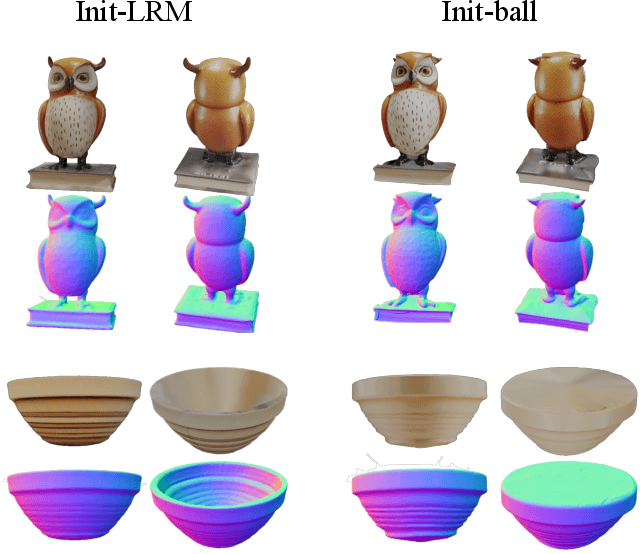

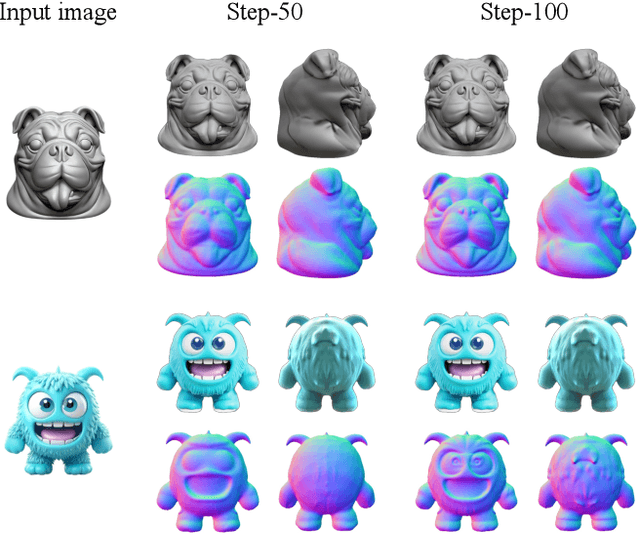
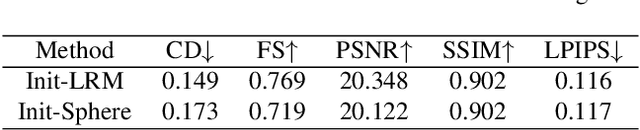
Diffusion models have achieved great success in generating 2D images. However, the quality and generalizability of 3D content generation remain limited. State-of-the-art methods often require large-scale 3D assets for training, which are challenging to collect. In this work, we introduce Kiss3DGen (Keep It Simple and Straightforward in 3D Generation), an efficient framework for generating, editing, and enhancing 3D objects by repurposing a well-trained 2D image diffusion model for 3D generation. Specifically, we fine-tune a diffusion model to generate ''3D Bundle Image'', a tiled representation composed of multi-view images and their corresponding normal maps. The normal maps are then used to reconstruct a 3D mesh, and the multi-view images provide texture mapping, resulting in a complete 3D model. This simple method effectively transforms the 3D generation problem into a 2D image generation task, maximizing the utilization of knowledge in pretrained diffusion models. Furthermore, we demonstrate that our Kiss3DGen model is compatible with various diffusion model techniques, enabling advanced features such as 3D editing, mesh and texture enhancement, etc. Through extensive experiments, we demonstrate the effectiveness of our approach, showcasing its ability to produce high-quality 3D models efficiently.
Uni-Renderer: Unifying Rendering and Inverse Rendering Via Dual Stream Diffusion
Dec 19, 2024

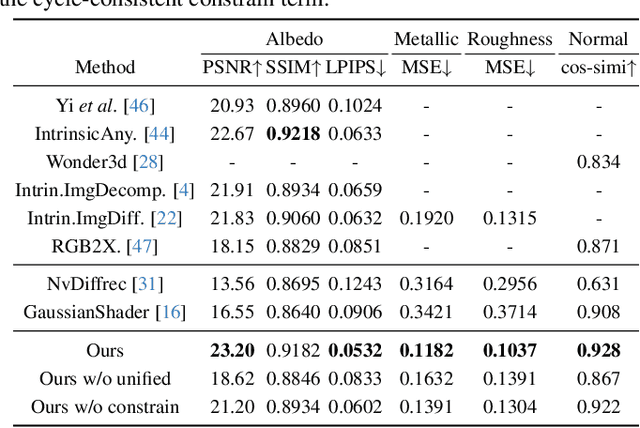

Rendering and inverse rendering are pivotal tasks in both computer vision and graphics. The rendering equation is the core of the two tasks, as an ideal conditional distribution transfer function from intrinsic properties to RGB images. Despite achieving promising results of existing rendering methods, they merely approximate the ideal estimation for a specific scene and come with a high computational cost. Additionally, the inverse conditional distribution transfer is intractable due to the inherent ambiguity. To address these challenges, we propose a data-driven method that jointly models rendering and inverse rendering as two conditional generation tasks within a single diffusion framework. Inspired by UniDiffuser, we utilize two distinct time schedules to model both tasks, and with a tailored dual streaming module, we achieve cross-conditioning of two pre-trained diffusion models. This unified approach, named Uni-Renderer, allows the two processes to facilitate each other through a cycle-consistent constrain, mitigating ambiguity by enforcing consistency between intrinsic properties and rendered images. Combined with a meticulously prepared dataset, our method effectively decomposition of intrinsic properties and demonstrates a strong capability to recognize changes during rendering. We will open-source our training and inference code to the public, fostering further research and development in this area.
Motion Dreamer: Realizing Physically Coherent Video Generation through Scene-Aware Motion Reasoning
Nov 30, 2024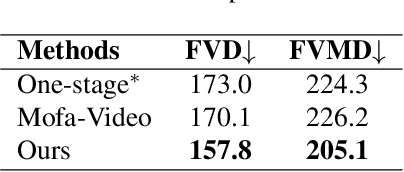
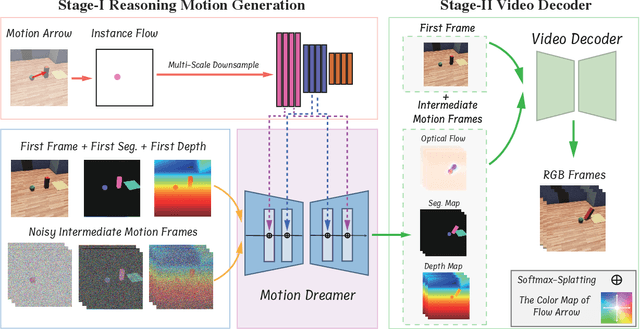
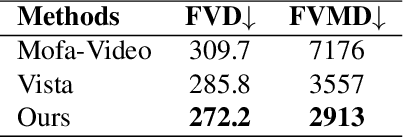
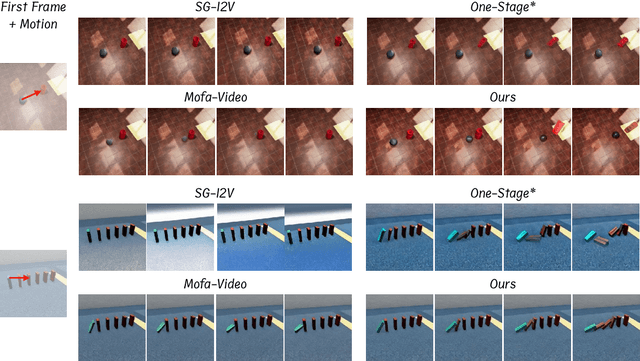
Recent numerous video generation models, also known as world models, have demonstrated the ability to generate plausible real-world videos. However, many studies have shown that these models often produce motion results lacking logical or physical coherence. In this paper, we revisit video generation models and find that single-stage approaches struggle to produce high-quality results while maintaining coherent motion reasoning. To address this issue, we propose \textbf{Motion Dreamer}, a two-stage video generation framework. In Stage I, the model generates an intermediate motion representation-such as a segmentation map or depth map-based on the input image and motion conditions, focusing solely on the motion itself. In Stage II, the model uses this intermediate motion representation as a condition to generate a high-detail video. By decoupling motion reasoning from high-fidelity video synthesis, our approach allows for more accurate and physically plausible motion generation. We validate the effectiveness of our approach on the Physion dataset and in autonomous driving scenarios. For example, given a single push, our model can synthesize the sequential toppling of a set of dominoes. Similarly, by varying the movements of ego-cars, our model can produce different effects on other vehicles. Our work opens new avenues in creating models that can reason about physical interactions in a more coherent and realistic manner.